When Apple launched the App Store in July 2008, the iPhone already existed for a year earlier with 15 apps—all of them made by Apple. Steve Jobs, famously, didn't want third-party developers on the device at all. His concern was quality control. He feared that bad software would ruin what he'd built. He eventually gave in, and within a single weekend, the App Store clocked 10 million downloads. By September 2008—two months later—that number was 100 million. Not long after that, the phrase "there's an app for that" entered the cultural vocabulary.
The lesson here is that the right distribution layer, sitting on top of the right device, in the hands of the right users, produces outcomes that can surprise even the people who built it.
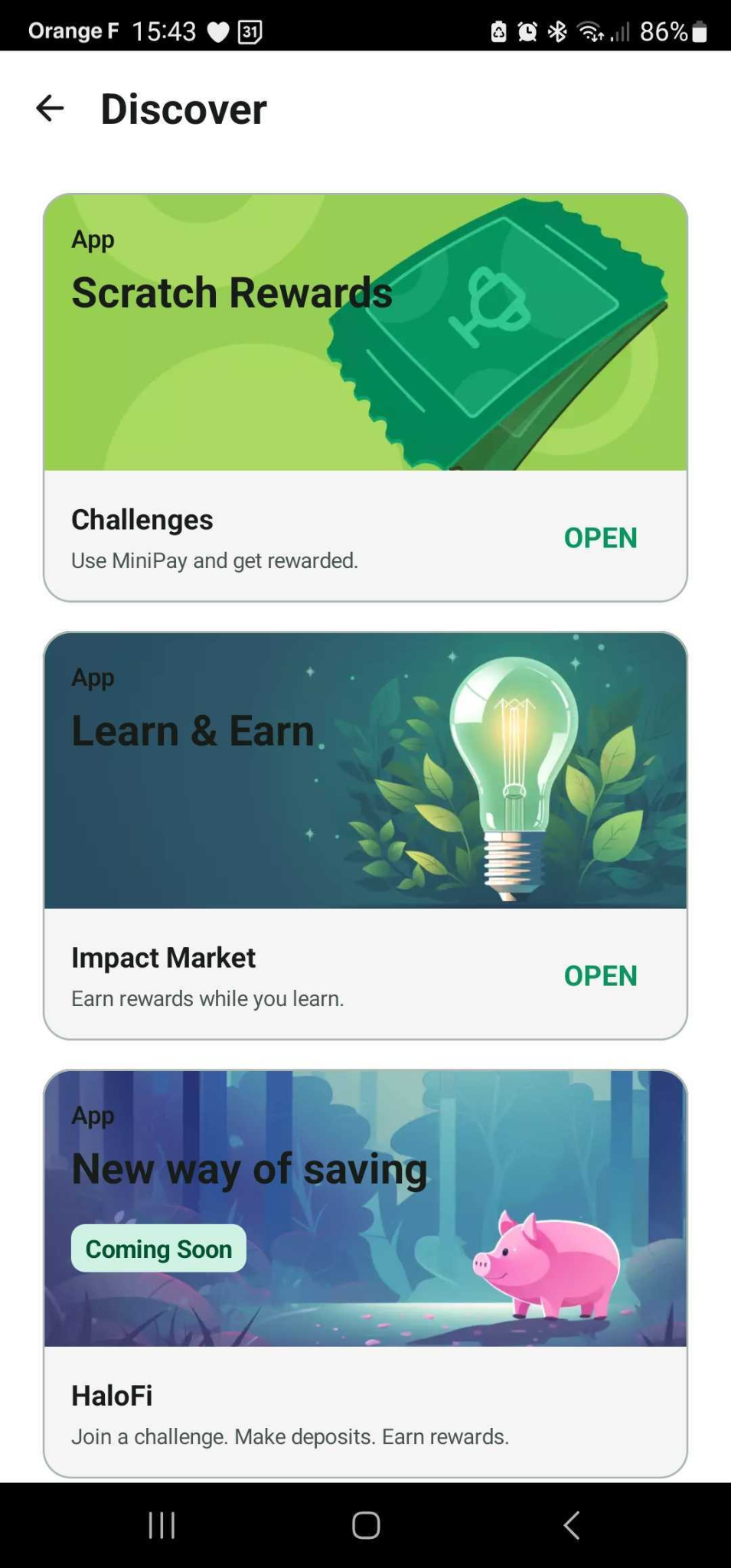
MiniPay launched in September 2023 with three core features: deposit, withdraw, and send. Useful, yes, but real finance is messier and more human than that. If the goal was better, simpler, global money, it needed to do more. The Discover Page—MiniPay's equivalent of the App Store shelf—was the first bet that more would come.
50,000 reasons to believe
One of the first Mini Apps to go live in MiniPay was GoodDollar, a UBI dapp, which was almost too suspiciously well-matched for MiniPay's initial launch markets at the time: Nigeria, Kenya, Ghana, South Africa. These were exactly the populations UBI is meant to serve, and the fit spoke for itself.
Within weeks of launching, GoodDollar was seeing over 50,000 daily claims from Nigeria alone.
The UBI being distributed was fractions of a cent. By most standards, invisible money. But somewhere in the world, 50,000 people were coming back every single day to claim it. Not because they were incentivised by a token airdrop, but because it was worth something to them.
Without MiniPay, that journey would have looked something like this:
Create a crypto wallet -> Connect wallet to GoodDollar -> Claim UBI -> Repeat every day -> Find a way to convert G$ to something spendable -> FInally find a supporting wallet to send to -> Swap for another token -> Pay gas in a third different token -> Finally withdraw via P2P somehow
Inside MiniPay, it was two steps for most users. That friction evaporated.
Then came the really useful apps
Before long, apps offering real-world spend started getting integrated. BitGifty and Pretium were two of the early ones, and both were doing something profound, in a simple way.
BitGifty let users in Nigeria, Kenya and Ghana and more pay for electricity, cable subscriptions, airtime, data—all the recurring costs of daily life—directly from their stablecoin balance. No P2P. No CEX. No waiting. Pretium went one further: it let users in Kenya settle payments to local merchants via M-PESA—the dominant mobile money rail in the country—using stablecoins.
Let’s think about what that replaced. A user saving in USDT to hedge against inflation was most likely doing it through a CEX like Binance, topping up via P2P, and then navigating a friction-heavy exit every time they needed to spend in the real world. The whole thing was technically possible but practically exhausting.
Both apps saw thousands of daily active users within days of going live in MiniPay. Not weeks. Days. That's product-market fit meeting the right distribution.
BitGifty is probably the clearest case study here. It was bootstrapped with no real marketing budget, no token. Just a useful idea, built during a hackathon with Celo Camp, plugged into MiniPay. Today it has hundreds of thousands of active users and processes transactions daily across 10+ countries. Their own words: "MiniPay has been instrumental in BitGifty achieving product-market fit."
Steve Jobs said the App Store would "put large and small developers on an even playing field, and put their apps in front of every iPhone user on the planet." MiniPay, for what it's worth, is doing something similar and the stakes of the apps are considerably more immediate.
The apps get a lot more than just distribution
Here's what often gets missed in the MiniPay story, and it might be the most important thing for builders to understand.
Every Mini App integrated into MiniPay automatically inherits MiniPay's cash-in/cash-out infrastructure. Not as something to build. Not as a partnership to negotiate. Just, automatically, as part of being in the ecosystem.
That orchestration layer—powered by over 20 strategic partnerships—now spans 70+ countries, 50+ local currencies and payment methods globally. A user in Brazil deposits using PIX. A user in Nigeria withdraws via bank transfer. Each experience carries local context, local rails, local feel.
For most dApps, three questions consume months of engineering and business development before a single real user shows up:
- How do people find this?
- How do they get money in?
- How do they get money out?
Inside MiniPay, those questions are already answered before the first line of product code is written. That's the difference between building a product and building an entire ecosystem from scratch.
Fast-forward to now.
The early Mini App landscape was shaped by necessity—UBI, bills, payments. Real-world utility for people who needed it. That era validated the model. What's happening now is something more.
While more and more incredibly important use cases like digital gold, yield, and microwork are coming to life in the app, we’ve also started to see vibe-coded Mini Apps like MiniPlay, Oracle 360, Squadletics, and Melorize have gone from zero to live in days—bringing gaming, predictions, fitness challenges, music into a wallet that started its life moving stablecoins between phone numbers. The diversity of use cases is becoming the point. When builders feel comfortable enough to experiment, and that experimentation is met with validation, it’s proof that an ecosystem is maturing.
MiniPay has since crossed 20 million activated wallets and 400 million transactions. That growth is real, and increasingly, Mini Apps are part of the reason users are coming back—to play, to save, to compete, to explore. The wallet is becoming a daily habit, and Mini Apps are a part of the story.
So what do we mean by “out of hand”?
It means the volume of ideas. The speed of shipping. The range of use cases that are finding real users in real time. It means a bootstrapped team can go from a hackathon to over a million users without a marketing budget, because the distribution was already there.
Back in 2008, the App Store launched with 500 apps. By September that year it had 3,000, and 100 million downloads. Nobody had planned for that pace—they just built the conditions for it and got out of the way.
MiniPay started with three features and a Discover Page. The rest, it turns out, was up to the builders.
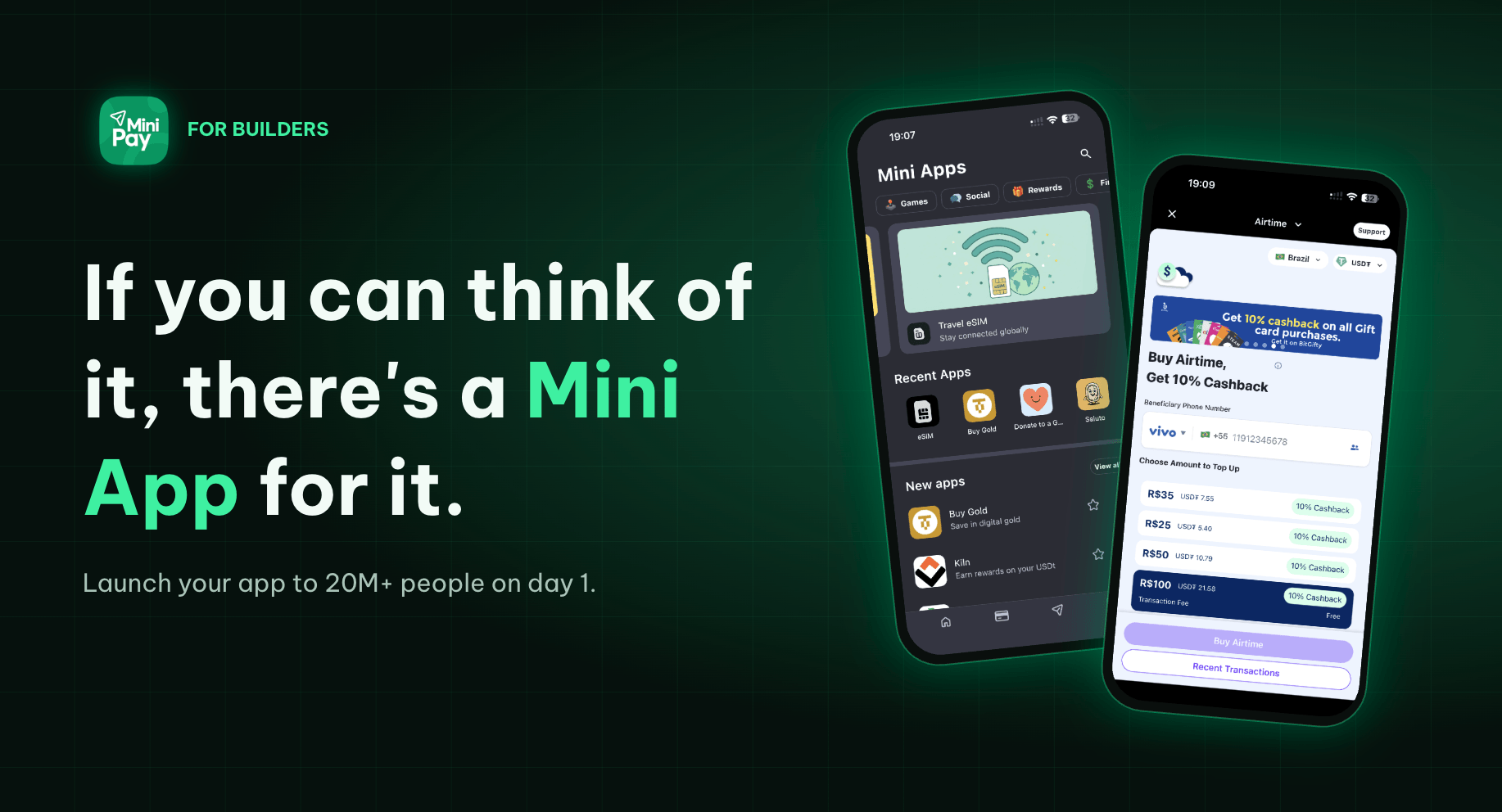
If you can think of it, there's probably a Mini App for it. And if there isn't yet…well. You know what to do.
Skip the Agents. Take Control.
Global Money App